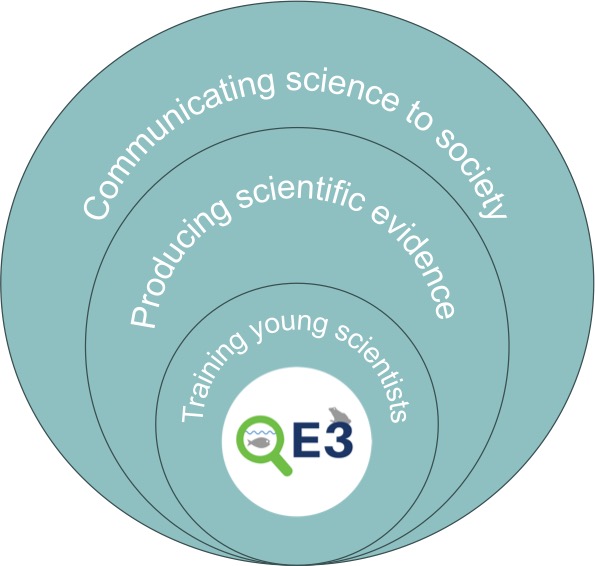
The QE3 Research Group has three spheres of impact.
First, we train students and early career researchers in interdisciplinary, ecosystem-centric approaches to ecotoxicology.
Second, we produce scientific evidence on the fate and toxic effects of aquatic contaminants on wildlife and their environment.
Third, we communicate science to public audiences, government departments, and policy makers to inspire real-world change.
Training Young Scientists
Undergraduate students
- Kosichek, H. (2018) Responses of freshwater phytoplankton to diluted bitumen oil exposure. Honours Thesis, Department of Biology. URL
- Halliwell, L. (2018) Effects of snow from Athabasca oil sands region on early life stages of fathead minnows (Pimephales promelas). Honours Thesis, School of Environmental Studies.
- Reynolds, J. (2019) Effectiveness of a novel photocatalysis treatment to reduce oil sands process-affected water toxicity to developing fathead minnow (Pimephales promelas). Honours Thesis, Department of Biology. URL
- Weder, J. (2019) Investigating the effects of an herbicide on the nutritional quality of periphyton for larval fish. Honours Thesis, Department of Biology. URL
- Dias, M. (2020) Microplastics in lake sediments of the IISD-Experimental Lakes Area. Honours Thesis, School of Environmental Studies. URL
- Brouwer, K. (2020) Effects of glyphosate accumulated by periphyton on growth and development of larval fish. Honours Thesis, School of Environmental Studies. URL
- Jackson, B. (2020) Embryotoxicity of naphthenic acid fraction components to fathead minnow (Pimephales promelas). Honours Thesis, School of Environmental Studies. URL
- Teboul, E. (2020) Chemical identification of microplastics ingested by Red Phalaropes (Phalaropus fulicarius) using Fourier Transform Infrared spectroscopy. Honours Thesis, Department of Chemistry.
- Watson, S. (2021) Anuran calling frequency and intensity in relation to precipitation levels. Honours Thesis, Department of Biology.
- Wong, S. (2021) Anuran calling frequency and intensity in relation to air temperature. Honours Thesis, Department of Biology.
- Lynch, K. (2023) Early-life survival, growth, and development of age-0 largemouth bass (Micropterus salmoides) in outdoor experimental mesocosms. Honours Thesis, Department of Biology. URL
- Schubert, E. (2023) The influence of rearing density and body size on boldness in largemouth bass (Micropterus salmoides). Honours Thesis, Department of Biology. URL
- Resendes, A. (2023) Microplastic sedimentation rates in a boreal lake following experimental additions of low-density polyethylene (LDPE), polyethylene terephthalate (PET), and polystyrene (PS). Honours Thesis, School of Environmental Studies.
- Moran-Macdonald, H. (2023) Microplastic sedimentation rates in a boreal lake following experimental additions of low-density polyethylene (LDPE), polyethylene terephthalate (PET), and polystyrene (PS). Honours Thesis, School of Environmental Studies.
Graduate students
- Patterson, S. (2019) The toxic effects of oil sands contaminants on developing amphibians. MES Thesis, School of Environmental Studies. URL
- Mason, J. (2019) Stable isotope analysis reveals the minimal incorporation of petrogenic carbon into a freshwater food web following experimental diluted bitumen spills. MES Thesis, School of Environmental Studies. URL
- Hataley, E. (2020) Sorption of the common freshwater cyanotoxin microcystin to microplastics. MES Thesis, School of Environmental Studies. URL
- Reynolds, J. (2021) The toxic effects of oil sands contaminants on fish. MSc Thesis, Department of Biology. URL
- Vanderlip, H. (2021) Trends in halogenated flame retardants in herring gull eggs across Canada from 2009 – 2019. MSc Thesis, Department of Biology. URL
- Cederwall, J. (2022) Life under an oil slick: response of a freshwater food web to simulated spills of diluted bitumen in mesocosms. MSc Thesis, Department of Biology. URL
- Johnson, L. (2022) Weaving knowledge systems in wildlife and ecosystem health. MES Thesis, School of Environmental Studies. URL
- Robinson, C. (2022) Naphthenic acid fraction compounds reduce the reproductive success of wood frogs (Rana sylvatica). MSc Thesis, Department of Biology. URL
- Neves, N. (2023) Multi-level response of benthic macroinvertebrates to experimental microplastic pollution in a boreal lake. MSc Thesis, Department of Biology. URL
- Iyare, P. (2023) An assessment of microplastics in fecal samples from polar bears (Ursus maritimus) in Canada’s North. MES Thesis, School of Environmental Studies. URL
- Lewis, Y. (2024) The effects of microplastics on zooplankton and emerging insect communities in the littoral zone of a boreal lake. MSc Thesis, Department of Biology. URL
Postdoctoral fellow and research associates
- Madison, B. (2018) Research Associate.
- Elvidge, C. (2021-2022) Research Associate.
- Robichaud, C. (2021) Postdoctoral Fellow.
- Juurunko, C. (2022) Research Associate.
- Graves, S. (2021-2023) Postdoctoral Fellow.
Producing Scientific Evidence
Effects of oil sands tailings ponds on aquatic biota
Reynolds J.S., Elvidge C.K., Vander Meulen I.J., Hasler C.T., Frank R.A., Headley J.V., Hewitt L.M., Orihel D.M. 2024. Naphthenic acid fraction compounds, produced by the extraction of bitumen from oil sands, alter survival and behaviour of juvenile yellow perch (Perca flavescens). FACETS 9:1-12. DOI: 10.1139/facets-2022-0176.
Robinson C.E., Elvidge C.K., Frank R.A., Headley J.V., Hewitt L.M., Little A.G., Robinson S.A., Trudeau V.L., Meulen I.J.V., Orihel D.M. 2023. Naphthenic acid fraction compounds reduce the reproductive success of wood frogs (Rana sylvatica) by affecting offspring viability. Environmental Pollution 316:120455. DOI: 10.1016/j.envpol.2022.120455.
Elvidge C.K., Robinson C.E., Caza R.A., Hewitt L.M., Frank R.A., Orihel D.M. 2023. Chemical communication in wood frog (Rana sylvatica) tadpoles is influenced by early-life exposure to naphthenic acid fraction compounds. Aquatic Toxicology 257:106435. DOI: 10.1016/j.aquatox.2023.106435.
Reynolds J.S., Jackson B.L., Madison B.N., Elvidge C.K., Frank R.A., Hasler C.T., Headley J.V., Hewitt L.M., Peru K.M., Yakimowski S.B., Orihel D.M. 2022. Fathead minnows exposed to organic compounds from oil sands tailings as embryos have reduced survival, impaired development, and altered behaviors that persist into larval stages. Environmental Toxicology and Chemistry 41:1319–1332. DOI: 10.1002/etc.5314.
Madison B.N., Reynolds J., Halliwell L., Leshuk T., Gu F., Peru K.M., Headley J.V., Orihel D.M. 2020. Can the toxicity of naphthenic acids in oil sands process-affected water be mitigated by a green photocatalytic method? FACETS 5:474-487. DOI: 10.1139/facets-2019-0053.
Pipeline spills of diluted bitumen in boreal lakes
Stoyanovich S.S., Saunders L.J., Yang Z., Hanson M.L., Hollebone B.P., Orihel D.M., Palace V., Rodriguez-Gil J.L., Mirnaghi F.S., Shah K., Blais J.M. 2023. Chemical weathering patterns of diluted bitumen spilled into freshwater limnocorrals. Environmental Science & Technology 57:9266-9276. DOI: 10.1021/acs.est.2c05468.
Graves S.D., Mason J.J., Rodriguez-Gil J.L., Seguin J.Y., Blais J.M., Hanson M.L., Hollebone B.P., Palace V.P., Clark I., Cundall L., Layton-Matthews D., Leybourne M.I., Orihel D.M. 2023. Radio- and stable carbon isotope analysis reveals minimal assimilation of petrogenic carbon into an oligotrophic freshwater food web after experimental spills of diluted bitumen. Chemosphere 329:138608. DOI: 10.1016/j.chemosphere.2023.138608.
Black T., Paterson M.J., Timlick L., Cederwall J., Blais J.M., Hollebone B., Orihel D.M., Palace V.P., Rodriguez-Gil J.L., Hanson M.L. 2023. The challenges of characterizing the zooplankton community response following simulated spills of diluted bitumen into boreal lake limnocorrals. Bulletin of Environmental Contamination and Toxicology 110:46. DOI: 10.1007/s00128-022-03680-7.
Timlick L., Dearnley J., Blais J.M., Rodríguez-Gil J.L., Hanson M., Hollebone B.P., Orihel D.M., Peters L.E., Stoyanovich S.S., Palace V.P. 2022. Responses of wild finescale dace (Phoxinus neogaeus) to experimental spills of Cold Lake Blend diluted bitumen at the International Institute for Sustainable Development-Experimental Lakes Area, northwestern Ontario. Environmental Toxicology and Chemistry 41:2745-2757. DOI: 10.1002/etc.5457.
Stoyanovich S., Yang Z., Hanson M., Hollebone B.P., Orihel D.M., Palace V., Rodriguez-Gil J.R., Mirnaghi F., Shah K., Blais J.M. 2022. Fate of polycyclic aromatic compounds from diluted bitumen spilled into freshwater limnocorrals. Science of the Total Environment 819:151993. DOI: 10.1016/j.scitotenv.2021.151993.
Séguin J.Y., Mason J., Hanson M.L., Hollebone B.P., Orihel D.M., Palace V.P., Rodriguez-Gil J.L., Blais J.M. 2022. Bioaccumulation and toxicokinetics of polycyclic aromatic compounds and metals in giant floater mussels (Pyganodon grandis) exposed to a simulated diluted bitumen spill. Aquatic Toxicology 252:106316. DOI: 10.1016/j.aquatox.2022.106316.
Saunders L.J., Rodriguez-Gil J.L., Stoyanovich S.S., Kimpe L.E., Hanson M.L., Hollebone B.P., Orihel D.M., Blais J.M. 2022. Effect of spilled diluted bitumen on chemical air-water exchange in boreal lake limnocorrals. Chemosphere 291:132708. DOI: 10.1016/j.chemosphere.2021.132708.
Patterson S.A., Denton D.T.J., Hasler C.T., Blais J.M., Hanson M.L., Hollebone B.P., Rodriguez-Gil J.L., Langlois V.S., Patey G., Yang Z., Orihel D.M. 2022. Resilience of larval wood frogs (Rana sylvatica) to hydrocarbons and other compounds released from naturally weathered diluted bitumen in a boreal lake. Aquatic Toxicology 245:106128. DOI: 10.1016/j.aquatox.2022.106128.
Stoyanovich S., Rodriguez-Gil J.R., Hanson M.L., Hollebone B.P., Orihel D.M., Palace V.P., Faragher R., Mirnaghi F.S., Shah K., Yang Z., Blais J.M. 2021. Simulating diluted bitumen spills in boreal lake limnocorrals – Part 2: Factors affecting the physical characteristics and submergence of diluted bitumen. Science of the Total Environment 790:148580. DOI: 10.1016/j.scitotenv.2021.148580.
Rodriguez-Gil J.L., Stoyanovich S., Hanson M.L., Hollebone B., Orihel D.M., Palace V., Faragher R., Mirnaghi F.S., Shah K., Yang Z., Black T.A., Cederwall J., Mason J., Patterson S., Timlick L., Seguin J.Y., Blais J.M. 2021. Simulating diluted bitumen spills in boreal lake limnocorrals – Part 1: Experimental design and responses of hydrocarbons, metals, and water quality parameters. Science of the Total Environment 790:148537. DOI: 10.1016/j.scitotenv.2021.148537.
Black T.A., White M.S., Blais J.M., Hollebone B., Orihel D.M., Palace V.P., Rodriguez-Gil J.L., Hanson M.L. 2021. Surface oil is the primary driver of macroinvertebrate impacts following spills of diluted bitumen in freshwater. Environmental Pollution 290:117929. DOI: 10.1016/j.envpol.2021.117929.
Cederwall J., Black T.A., Blais J.M., Hanson M.L., Hollebone B.P., Palace V.P., Rodríguez-Gil J.L., Greer C.W., Maynard C., Ortmann A.C., Rooney R.C., Orihel D.M. 2020. Life under an oil slick: response of a freshwater food web to simulated spills of diluted bitumen in field mesocosms. Canadian Journal of Fisheries and Aquatic Sciences 77:779-788. DOI: 10.1139/cjfas-2019-0224.
Stoyanovich S.S., Yang Z., Hanson M., Hollebone B.P., Orihel D.M., Palace V., Rodriguez-Gil J.L., Faragher R., Mirnaghi F.S., Shah K., Blais J.M. 2019. Simulating a spill of diluted bitumen: environmental weathering and submergence in a model freshwater system. Environmental Toxicology and Chemistry 38:2621-2628. DOI:10.1002/etc.4600.
Fate and effects of microplastics in the environment
Gene S.M., Katzenback B.A., Wilson J., Mallory M.L., Provencher J.F., Steele E., Orihel D.M. in press. The effects of a microplastic mixture on wood frogs (Rana sylvatica) across multiple life stages in an outdoor mesocosm experiment. Environmental Toxicology & Chemistry.
Covernton G.A., Metherel A.H., McMeans B.C., Bucci K., Langenfeld D., Veneruzzo C., Hoffman M.J., Orihel D.M., Paterson M.J., Provencher J.F., Rennie M.D., Rochman C.M. in press. Increasing microplastic exposure had minimal effects on fatty acid composition in zooplankton and yellow perch in a large, in-lake mesocosm experiment. Freshwater Biology. DOI: 10.1139/cjfas-2024-0149.
Rochman C., Bucci K., Langenfeld D., McNamee R., Veneruzzo C., Covernton G., Gao G., Ghosh M., Cable R., Hermabessiere L., Lezcano R., Paterson M., Rennie M., Rooney R., Helm P., Duhaime M., Hoellein T., Jeffries K., Hoffman M., Orihel D., Provencher J. 2024. Informing the exposure landscape: the fate of microplastics in a large pelagic in-lake mesocosm experiment. Environmental Science & Technology 58:7998−8008. DOI: 10.1021/acs.est.3c08990.
McIlwraith H.K., Dias M., Orihel D.M., Rennie M.D., Harrison A.L., Hoffman M.J., Provencher J.F., Rochman C.M. 2024. A multicompartment assessment of microplastic contamination in semi-remote boreal lakes. Environmental Toxicology & Chemistry. DOI: 10.1002/etc.5832.
Iyare P.U., Vanderlip H.L., Dias M., Provencher J.F., Zou S., Lougheed S.C., de Groot P.V.C., Whitelaw G., Branigan M., Dyck M., Orihel D.M. 2024. An assessment of microplastics in fecal samples from polar bears (Ursus maritimus) in Canada’s North. Arctic Science 10:409–423 DOI: 10.1139/AS-2023-0060.
Hataley E.K., Shahmohamadloo R.S., Almirall X.O., Harrison A.L., Rochman C.M., Zou S., Orihel D.M. 2022. Experimental evidence from the field that naturally weathered microplastics accumulate cyanobacterial toxins in eutrophic lakes. Environmental Toxicology and Chemistry 41:3017-3028. DOI: 10.1002/etc.5485.
Teboul E., Orihel D.M., Provencher J.F., Drever M.C., Wilson L., Harrison A.L. 2021. Chemical identification of microplastics ingested by Red Phalaropes (Phalaropus fulicarius) using Fourier Transform Infrared spectroscopy. Marine Pollution Bulletin 171:112640. DOI: 10.1016/j.marpolbul.2021.112640.
Nutrient cycling and harmful algal blooms
Hataley E.K., Shahmohamadloo R.S., Almirall X.O., Harrison A.L., Rochman C.M., Zou S., Orihel D.M. 2022. Experimental evidence from the field that naturally weathered microplastics accumulate cyanobacterial toxins in eutrophic lakes. Environmental Toxicology and Chemistry 41:3017-3028. DOI: 10.1002/etc.5485.
O’Connell D.W., Ansems N., Kukkadapu R.K., Jaisi D., Orihel D.M., Cade‐Menun B.J., Hu Y., Wiklund J., Hall R.I., Chessell H., Behrends T., Van Cappellen P. 2020. Changes in sedimentary phosphorus burial following artificial eutrophication of Lake 227, Experimental Lakes Area, Ontario, Canada. Journal of Geophysical Research: Biogeosciences 125:e2020JG005713. DOI: 10.1029/2020jg005713.
Schindler D.W., Carpenter S.R., Chapra S.C., Hecky R.E., Orihel D.M. 2017. Response to the letter: Nitrogen is not a “House of Cards”. Environmental Science & Technology 51:1943. DOI: 10.1021/acs.est.6b06106.
Orihel D.M., Baulch H.M., Casson N.J., North R.L., Parsons C.T., Seckar D.C.M., Venkiteswaran J.J. 2017. Internal phosphorus loading in Canadian fresh waters: a critical review and data analysis. Canadian Journal of Fisheries and Aquatic Sciences 74:2005-2029. DOI: 10.1139/cjfas-2016-0500.
For Dr. Orihel’s publications on eutrophication prior to 2017, please see Google Scholar.
Weaving knowledge systems and biodiversity conservation
Johnson L.R., Wilcox A.A.E., Alexander S.M., Bowles E., Castleden H., Henri D.A., Provencher J.F., Orihel D.M. 2023. Weaving Indigenous and Western ways of knowing in ecotoxicology and wildlife health: a review of Canadian studies. Environmental Reviews 31:452–470. DOI: 10.1139/er-2022-0087.
Buxton R.T., Bennett J.R., Reid A.J., Shulman C., Cooke S.J., Francis C.M., Nyboer E.A., Pritchard G., Binley A.D., Avery-Gomm S., Ban N.C., Beazley K.F., Bennett E., Blight L.K., Bortolotti L.E., Camfield A.F., Gadallah F., Jacob A.L., Naujokaitis-Lewis I., Raudsepp-Hearne C., Roche D.G., Soulard F., Stralberg D., Sadler K.D., Solarik K.A., Ziter C.D., Brandt J., McKindsey C.W., Greenwood D.A., Boxall P.C., Ngolah C.F., Chan K.M.A., Lapen D., Poser S., Girard J., Dibacco C., Hayne S., Orihel D., Lewis D., Littlechild D., Marshall S.J., McDermott L., Whitlow R., Browne D., Sunday J., Smith P.A. 2021. Key information needs to move from knowledge to action for biodiversity conservation in Canada. Biological Conservation 256:108983. DOI: 10.1016/j.biocon.2021.108983.
Cooke S.J., Rytwinski T., Taylor J.J., Nyboer E.A., Nguyen V.M., Bennett J.R., Young N., Aitken S., Auld G., Lane J.-F., Prior K.A., Smokorowski K.E., Smith P.A., Jacob A.L., Browne D.R., Blais J.M., Kerr J.T., Ormeci B., Alexander S.M., Burn C.R., Buxton R.T., Orihel D.M., Vermaire J.C., Murray D.L., Simon P., Edwards K.A., Clarke J., Xenopoulos M.A., Gregory-Eaves I., Bennett E.M., Smol J.P. 2020. On “success” in applied environmental research — What is it, how can it be achieved, and how does one know when it has been achieved? Environmental Reviews 28:357-372. DOI: 10.1139/er-2020-0045.
McCune J.L., Colla S.R., Coristine L.E., Davy C.M., Flockhart D.T.T., Schuster R., Orihel D.M. 2019. Are we accurately estimating the potential role of pollution in the decline of species at risk in Canada? FACETS 4:598-614. DOI: 10.1139/facets-2019-0025.
Coristine L.E., Colla S., Bennett N., Carlsson A.M., Davy C., Davies K.T.A., Favaro B., Flockhart D.T.T., Fraser K., Orihel D., Otto S.P., Palen W., Polfus J.L., Venter O., Ford A.T. 2019. National contributions to global ecosystem values. Conservation Biology 33:1219-1223. DOI: 10.1111/cobi.13284.
Coristine L.E., Jacob A.L., Schuster R., Otto S.P., Baron N.E., Bennett N.J., Bittick S.J., Dey C., Favaro B., Ford A., Nowlan L., Orihel D., Palen W.J., Polfus J.L., Shiffman D.S., Venter O., Woodley S., Hutchings J. 2018. Informing Canada’s commitment to biodiversity conservation: A science-based framework to help guide protected areas designation through Target 1 and beyond. FACETS 3:531-562. DOI: 10.1139/facets-2017-0102.
Communicating Science to Society
Selected popular articles
Orihel D.M., Robinson C.E., Elvidge C.K. 2023. As Alberta’s oilsands continue leaking toxic wastewater, aquatic wildlife face new risks. The Conversation. Reprinted in The Narwhal.
Johnson L.R., Orihel D.M. 2023. Weaving Indigenous and western ways of knowing can help Canada achieve its biodiversity goals. The Conversation.
Orihel D.M., Reynolds J.S. 2020. New technology makes wastewater from the oilsands industry safer for fish. The Conversation.
Orihel D.M. 2019. Wildlife are exposed to more pollution than previously thought. The Conversation.
Orihel D.M. 2019. Why we spilled oil for science. Canadian Geographic.
Selected media interviews
Learn J. 2023. Chemicals from oil sands could hinder frog development. The Wildlife Society.
Chagas C. 2022. Queen’s joins Lake Ontario cleanup project. Queen’s Gazette.
MacDonald B. 2020. Oil sands tailings ponds are toxic. Canadian-made nanotech could help fix that. CBC Radio’s Quirks & Quarks.
Semeniuk I. 2019. Slick science: How researchers are preparing for Canada’s next major oil spill. The Globe and Mail.
Lougheed T. 2019. Feature Story: Deliberating on dilbit. Queen’s University.
Rajah L. 2018. What you should know about toxic blue-green algae blooms. CBC Technology & Science.
Ogden L.E. 2018. How a deliberate oil spill will help protect the environment. BBC Future.
Wootton J. 2017. Study finds toxins prevalent in Canadian lakes. Cottage Life.
Owens B. 2017. What happens when oil sands pipelines spill? Inside Science.
Selected science and policy briefings
(11/30/23) Invited testimony at the Standing Committee on Environment and Sustainable Development, Meeting 88, 44th Parliament, House of Commons Canada.
(11/10/23) Invited presentation at the National Contaminants Advisory Group Microplastic Workshop, Fisheries & Oceans Canada.
(01/12/22) Invited presentation at the Federal Plastic Science Knowledge Mobilization Workshop, Environment Canada and Climate Change.
(09/11/21) Invited participant at Science Café on Plastic Pollution Science Framework, Environment Canada and Climate Change.
 Queen's Experimental Ecotoxicology for Environmental Policy